
Vending machines as a business can sound almost too simple at first. Buy a machine. Put it somewhere. Fill it with snacks and drinks. People buy things. You collect the money. Done, right? Well… not exactly. The more I researched the vending industry, the more I realized that the vending machine itself is only one piece of the puzzle.
The real business is everything that happens around the machine.
You have to find a location. You have to figure out what customers actually want. You have to keep the machine stocked. You have to deal with repairs. You have to understand payment processing. You have to watch your expenses. And, most importantly, you have to make sure the location makes financial sense.
That’s what I want to explain in this guide.
If you’re thinking about starting vending machines as a business, especially if you’re starting with very little money, I’ll walk you through what I would look at before spending a dollar.
Affiliate Disclosure: This article contains affiliate links. If you purchase a vending machine or related product through one of my affiliate links, I may earn a commission at no additional cost to you. I only recommend that you research the company, equipment, pricing, warranty, payment system, and terms before making a purchase.
What Does a Vending Machine Business Actually Look Like?
At its simplest, a vending business is a small retail operation.
Instead of renting a traditional storefront, you’re placing your products inside an unattended machine.
The customer walks up.
They choose a product.
They pay.
The machine dispenses it.
You earn the difference between what the customer pays and what it costs you to operate the business.
But there’s a catch.
The machine doesn’t create customers.
The location creates the opportunity.
That’s one of the biggest things I learned while researching this industry.
A $5,000 vending machine sitting in a garage makes $0 in sales.
A basic machine in the right location can potentially be much more useful.
That doesn’t mean every good-looking location will be profitable. Vending operators on Reddit regularly point out that finding and maintaining good locations is one of the hardest parts of the business.
So when I think about vending now, I don’t think:
“I need to buy a vending machine.”
I think:
“I need to find a customer base that has a reason to use one.”
That’s a much better starting point.
Is a Vending Machine Business a Real Business?
Yes.
But I wouldn’t think of it as completely passive income.
That’s one of the biggest misconceptions I came across.
Someone has to:
- Purchase inventory
- Restock machines
- Remove expired products
- Clean machines
- Handle customer problems
- Fix or arrange repairs
- Monitor sales
- Collect or reconcile payments
- Talk to location owners
- Pay business expenses
- Keep records
- Find additional locations
One recent Reddit discussion from an operator described vending as something that requires real operational work, particularly around restocking, maintenance, and route management. Other operators describe vending as a business that can start small and grow over time.
That’s actually something I like about the model.
You don’t necessarily need to build a giant company on day one.
You can learn the business one machine at a time.
How Much Does It Cost to Start a Vending Business?
This is where things get interesting.
There isn’t one universal startup number.
Your cost depends on:
- Whether you buy new or used
- The type of machine
- Whether it accepts cashless payments
- Whether you need delivery or installation
- Initial inventory
- Insurance
- Licenses and permits
- Business registration
- Location costs
- Transportation
- Repairs
- Software or telemetry
- Your local requirements
NerdWallet currently estimates that a basic vending operation can potentially be started with around $2,000, while used machines can commonly fall in the $1,200–$3,000 range and new machines can cost substantially more. Other current estimates show a much wider range depending on the equipment and business model.
That tells me something important:
There isn’t a magic startup number.
Someone buying one used machine and keeping everything extremely lean is playing a very different game from someone ordering five new smart machines.
A Simple Example Startup Budget
Here’s an example of how I would think about the expenses.
| Expense | Example Budget |
|---|---|
| Used/refurbished machine | $1,500–$3,000 |
| Initial inventory | $300–$700 |
| Cashless payment setup | Varies |
| Insurance | Varies |
| Business registration/licensing | Varies |
| Transportation | Varies |
| Repairs/emergency reserve | Varies |
| Potential starting range | Highly variable |
These aren’t promises or fixed industry prices. They’re simply a framework for thinking about the money you’ll need.
And there’s an important point here:
Don’t spend your entire budget on the machine.
If you spend every dollar you have buying equipment and then don’t have money for inventory, transportation, repairs, insurance, or other startup requirements, you’ve created a problem before you make your first sale.
I would much rather have a less expensive machine and some money left over than a beautiful machine and an empty bank account.
Can You Start a Vending Machine Business With No Money?
This is probably one of the most interesting questions for beginners.
And I want to be honest about it.
Starting a traditional vending business with literally $0 is extremely difficult.
There are real costs involved.
Even if someone gives you a free machine, you may still need inventory, transportation, insurance, permits, payment equipment, repairs, and other expenses.
But there is a big difference between:
“I have absolutely no money.”
and
“I don’t have thousands of dollars available to buy several vending machines.”
The second situation gives you options.
I’ve written a separate guide specifically about how to start a vending machine business with no money, but here are some of the strategies I would investigate.
Strategy #1 — Find the Location Before Buying the Machine
This might be my favorite strategy for someone on a tight budget.
Instead of thinking:
Buy machine → Find location
reverse it.
Think:
Find opportunity → Find location → Determine machine → Acquire machine
Why?
Because the location should influence the machine.
A manufacturing facility might need a snack-and-drink combo machine.
An apartment building might need something different.
A gym might have demand for healthy snacks, drinks, supplements, or specialty products.
A laundromat might have a completely different customer.
So why buy a machine first?
If you can identify a real opportunity first, you have something more valuable than a machine sitting in your garage.
You have a potential customer base.
Recent discussions from people starting vending businesses from scratch show that this location-first approach is something beginners are actively considering.

Strategy #2 — Buy Used Instead of New
A used machine can dramatically reduce the amount of money you need upfront.
But I wouldn’t buy the cheapest machine I could find.
There’s a difference between:
cheap
and
good value.
A properly maintained used machine could be an excellent starting point.
A broken machine with an attractive price tag could become a nightmare.
Before buying used, I would check:
- Does every selection work?
- Does the machine cool properly if refrigerated?
- Does the bill validator work?
- Does the coin mechanism work?
- Is the machine compatible with a modern cashless reader?
- Are replacement parts available?
- Is the machine MDB compatible if needed?
- Does the seller offer any warranty?
- Can I see the machine operating?
- How much will transportation cost?
I recently published a complete breakdown of new vs. used vending machines, including the advantages and risks of both options.
And one lesson keeps coming back:
A cheap machine in a bad location is still a bad investment.
Strategy #3 — Finance the Equipment
Financing is another possibility, but I would be careful here.
Financing can reduce the amount of cash needed upfront.
But it also creates a monthly obligation.
That means your machine has to generate enough money to cover:
Product costs + operating expenses + financing payment + other business expenses.
If sales don’t materialize, the payment doesn’t magically disappear.
So before financing anything, I’d run several scenarios.
What If Sales Are Great?
What happens if the machine performs better than expected?
What If Sales Are Average?
Can you still comfortably make the payment?
What If Sales Are Terrible?
Could you make the payments for several months while you figure out the location?
That’s the scenario I would care about most.
Don’t build a business plan around everything going perfectly.
Strategy #4 — Partner With Someone
This is another idea worth considering.
Maybe you have the time but not the money.
Someone else might have money but no time.
You could potentially create a partnership where one person contributes capital and the other handles operations.
But I wouldn’t do this casually.
Put everything in writing.
Who owns the machine?
Who owns the business?
Who buys inventory?
Who services the machine?
How are profits divided?
Who pays for repairs?
What happens if someone wants out?
What happens if the location disappears?
A simple handshake can feel great when everyone is excited.
It can feel very different six months later when money is involved.
Strategy #5 — Look for Creative Equipment Deals
If money is tight, I would watch for:
- Used machines
- Refurbished machines
- Businesses selling routes
- Liquidation sales
- Local business closures
- Equipment auctions
- Operators upgrading equipment
- Machines that need cosmetic work
- Seller financing
- Lease options
But I would never assume a cheap machine is automatically a good deal.
The goal isn’t:
Spend the least amount possible.
The goal is:
Acquire useful equipment without taking on unnecessary risk.
What Type of Vending Machine Should You Start With?
This is where beginners can get overwhelmed.
There are snack machines.
Drink machines.
Combo machines.
Refrigerated machines.
Frozen-food machines.
Coffee machines.
Fresh-food machines.
Smart coolers.
Micro markets.
Specialty vending machines.
And machines designed for very specific products.
My advice?
Don’t start by choosing the coolest machine.
Start by choosing the customer.
Ask:
What do these people actually want?
New vs. Used vs. Smart Machines
Here’s how I’d think about the options.
| Machine Type | Main Advantage | Main Concern |
|---|---|---|
| Used | Lower upfront cost | Condition |
| Refurbished | Potential balance of cost/reliability | Availability |
| New | Warranty and newer technology | Higher upfront cost |
| Smart machine | Technology and monitoring | Higher complexity/cost |
| Specialty machine | Can target a niche | Demand may be limited |
There isn’t a universal winner.
A $7,000 machine isn’t automatically better than a $2,000 machine.
The right machine is the one that makes sense for the location and customers.
Finding the Right Vending Machine Location
If I had to pick one topic for a beginner to spend serious time researching, it would probably be this one.
Location.
You can read my complete guide on how to find your first vending machine location, but here’s the short version.
I would look at:
- Number of potential customers
- How long people stay there
- Existing vending competition
- Nearby food options
- Visibility
- Security
- Access to electricity
- Hours of operation
- Ease of restocking
- Distance from other machines
- Who controls the property
- Whether the location owner is open to vending
I wouldn’t automatically chase the location with the most foot traffic.
I’d chase the location with the best combination of demand and convenience.
For example, 100 employees working an eight-hour shift with limited food choices could potentially be more interesting than thousands of people passing through a location where they already have dozens of food options.
That’s why location research matters.
Where Should Beginners Look for Locations?
If I were starting today, I’d look at several categories.
Manufacturing Facilities
Employees often work long shifts and may have scheduled breaks.
Warehouses
Large facilities can have significant employee populations.
Apartment Communities
Residents may appreciate convenient snacks and drinks without leaving the property.
Laundromats
People are already sitting around waiting.
Gyms
Customers may want drinks and snacks before or after workouts.
Auto Repair Shops
Customers sometimes spend a considerable amount of time waiting.
Hotels
Guests may want convenience outside normal store hours.
Offices
Employees may appreciate having snacks and drinks nearby.
Schools and Colleges
These can be interesting but may have specific policies and restrictions.
Hospitals and Medical Facilities
Potentially large audiences, but contracts and vendor requirements may make these locations more difficult to enter.
I wouldn’t assume every location type is profitable.
I’d research the individual location.
How I Would Find Locations for Free
This is where I think someone with almost no startup money can get creative.
You don’t necessarily need an expensive lead-generation service.
Start with tools you already have.
Google Maps
Search for:
- Warehouses
- Manufacturing
- Gyms
- Apartment complexes
- Laundromats
- Hotels
- Auto shops
- Offices
- Distribution centers
Then create a spreadsheet.
Drive Around Your Area
Look for:
NEW BUILDINGS.
This is something I think is easy to overlook.
A brand-new apartment complex or manufacturing facility may not have an established vending provider yet.
Talk to People You Already Know
Ask friends.
Family.
Former coworkers.
Neighbors.
Local business owners.
Your mechanic.
Your gym.
You never know who knows somebody who owns a business.
Don’t Buy a Machine Before You Understand the Location
This is worth repeating.
Let’s say I find a machine online for $2,500.
It looks great.
I buy it.
Then I spend three months trying to find somewhere to put it.
That’s backwards.
I’d rather have:
A location opportunity + no machine
than
A machine + no location.
The first problem is solvable.
The second problem can become expensive.
What About Cashless Payments?
I wouldn’t ignore this.
Modern vending customers increasingly expect convenient payment options.
Depending on the equipment, cashless systems can support credit cards, debit cards, contactless payments, and mobile wallets. Current vending equipment and payment providers commonly offer these options, although the exact features and fees vary by system.
That means a machine might accept:
- Cash
- Coins
- Credit cards
- Debit cards
- Tap-to-pay
- Apple Pay
- Google Pay
But cashless payments aren’t free.
You’ll need to consider:
- Hardware cost
- Processing fees
- Monthly service/connectivity fees
- Cellular connectivity
- Potential software costs
I explain the technology in much more detail in my guide on how cashless vending payments work.
What Does It Actually Take to Operate the Business?
This is the part that doesn’t look very exciting on YouTube.
But it’s the part I’d pay attention to.
Imagine you have five machines.
One needs restocking.
One has a card-reader problem.
One has expired products.
One needs a refund issued.
One is doing great.
Now imagine those machines are 30 miles apart.
Suddenly you’re not just selling snacks.
You’re managing a small logistics operation.
That’s why I think route density matters.
If you have five machines within a reasonable driving area, servicing them can be much easier than having five machines scattered across three cities.
The Expenses Beginners Need to Understand
Revenue is exciting.
Expenses are not.
But expenses determine whether the business actually works.
Potential expenses include:
- Machine purchase
- Inventory
- Card processing
- Location commissions
- Fuel
- Vehicle costs
- Repairs
- Insurance
- Business registration
- Permits
- Taxes
- Cellular service
- Software
- Spoilage
- Theft/shrinkage
- Replacement parts
- Labor
I’ve already gone much deeper into this in Vending Machine Business Expenses You Need to Know.

Revenue Is Not Profit
This is probably the most important financial lesson I would give a beginner.
Suppose a machine generates:
$1,000 in sales.
That doesn’t mean you made $1,000.
You still have to pay for the products.
Maybe the location gets a percentage.
There are card fees.
You drove to the machine.
You may have maintenance expenses.
There may be insurance and licensing costs.
There may be taxes.
So your calculation should look more like:
Sales − Product Cost − Location Costs − Payment Fees − Operating Expenses = Money Left Over
That’s why I don’t recommend building a vending business around huge sales claims.
I’ve seen plenty of discussions online where people ask what a vending machine can realistically earn, and the answers vary enormously because location quality, pricing, product mix, expenses, and service costs are different.
If you want to see the financial side broken down in more detail, check out How Much Profit Can a Vending Machine Really Make?.
What Legal and Business Setup Do You Need?
This is an area where I wouldn’t guess.
The rules can vary depending on your state, county, city, machine type, and products.
The U.S. Small Business Administration specifically notes that licenses and permits depend on the business activity and location, and lists vending machines among activities that can be regulated at the state or local level.
So before installing a machine, I would research:
- Business registration
- Local business licenses
- Vending permits
- Sales-tax requirements
- Food-related permits, if applicable
- Zoning requirements
- Insurance requirements
- Location agreements
Don’t assume that because somebody on YouTube operates a vending machine without a certain permit, you can do the same thing.
Their location may have completely different rules.
Do You Need an LLC?
Not necessarily.
An LLC is a business structure, and whether you choose one depends on your circumstances.
I wouldn’t create an LLC simply because somebody on social media said:
“You need an LLC to own a vending machine.”
That’s too simplistic.
The IRS explains that business owners need to consider their business structure, federal taxes, recordkeeping, and EIN requirements, while state and local requirements are separate issues.
If you’re serious about starting a business, I’d research your state’s requirements and consider talking with a qualified tax or legal professional about your specific situation.
What About an EIN?
An EIN is a federal Employer Identification Number.
The IRS provides EINs directly and does not charge a fee for the online application.
But here’s something important:
Not every sole proprietor automatically needs an EIN simply because they have a small business.
Your need for an EIN depends on your business structure and circumstances.
If you form an LLC, partnership, or corporation, the IRS generally requires an EIN for those entities.
Don’t pay some random website hundreds of dollars to “get your EIN.”
The IRS provides the application directly.
What Should You Sell?
This is where vending gets fun.
You don’t necessarily have to sell the same chips, candy and soda in every machine.
Your product mix should match your customers.
For example:
Office
- Bottled water
- Coffee
- Granola bars
- Chips
- Candy
- Healthy snacks
Gym
- Water
- Sports drinks
- Protein-oriented snacks
- Low-sugar drinks
Manufacturing Facility
- Energy drinks
- Water
- Chips
- Candy
- Quick meals/snacks
Apartment Complex
- Drinks
- Snacks
- Household convenience items
- Specialty products
The key is to watch what actually sells.
Don’t fall in love with your inventory.
If nobody buys something for three months, the machine is giving you data.
Move it.
Test something else.
Should You Sell Healthy Products?
You can.
But I wouldn’t assume “healthy” automatically means “profitable.”
I’d look at the audience.
A gym may have more demand for certain products than a manufacturing facility.
An office might have completely different preferences.
You could test:
- Low-sugar drinks
- Protein snacks
- Trail mix
- Granola bars
- Bottled water
- Fruit snacks
- Healthy chips
Then let your sales data tell you what customers actually want.
What Makes a Vending Business Different From Other Businesses?
One thing I like about the model is that it combines several businesses into one.
It’s part retail.
Part logistics.
Part sales.
Part customer service.
Part equipment management.
Part inventory management.
And part location acquisition.
That’s why I don’t think someone should enter vending thinking:
“I’m just buying machines.”
You’re really building a network of small retail locations.
The machines are the equipment that connects everything together.
Is Vending a Good Side Business?
It can be structured as a side business, but I’d be careful with the word passive.
If you have one or two machines, you may be able to service them around another job.
As the number of machines grows, so does the operational workload.
That could eventually mean:
- More inventory
- More driving
- More repairs
- More customer issues
- More location relationships
- More bookkeeping
- More route planning
Eventually, you may decide to hire help.
But I wouldn’t worry about that when you’re starting with one machine.
First learn the business.
How I Would Start If I Had Very Little Money
If I were starting from almost nothing, I wouldn’t immediately try to build a 20-machine vending route.
I’d make my first goal:
Get one location that makes financial sense.
Here’s my basic roadmap.
Step 1 — Pick a Small Service Area
Stay relatively close to home.
Step 2 — Research 25 Potential Locations
Use Google Maps, personal contacts, local businesses and driving around.
Step 3 — Find Out What Each Location Needs
Don’t pitch the same machine to everybody.
Step 4 — Contact the Decision-Makers
Don’t waste weeks talking to someone who can’t approve the machine.
Step 5 — Get the Agreement in Writing
Understand the terms before buying equipment.
Step 6 — Determine Which Machine Fits
Now you know what the location needs.
Step 7 — Find the Best Equipment Deal
Compare new, used and refurbished options.
Step 8 — Keep Cash in Reserve
Don’t spend every dollar on the machine.
Step 9 — Stock Carefully
Don’t overbuy inventory before you know what sells.
Step 10 — Track Everything
Sales.
Products.
Expenses.
Mileage.
Repairs.
Restocking time.
Location payments.
Everything.
What If I Don’t Have Enough Money for a Machine?
This is where I’d get creative rather than giving up.
I’d investigate:
- Used machines
- Refurbished machines
- Financing
- Partnerships
- Seller financing
- Revenue-sharing arrangements
- Equipment auctions
- Local business liquidations
- Existing vending routes
- Businesses selling old equipment
I’d also look for opportunities where the location itself has enough value to attract an equipment partner.
For example, if you have a strong relationship with a large business that wants vending, you may have something valuable even though you don’t own a machine yet.
That’s why I keep coming back to:
Find the opportunity first.
What About Buying a Vending Machine From Vendify?
Affiliate Disclosure: Vendify is one of the companies I promote through an affiliate relationship. If you purchase through one of my qualifying affiliate links, I may earn a commission at no additional cost to you.
Vendify USA currently offers several types of vending and unattended-retail equipment and says it ships machines across the continental United States. Its site also says customers who purchase a vending machine can receive assistance with finding a location and creating a business plan.
However, I would pay attention to the wording.
Vendify’s FAQ says location placement is not guaranteed unless specifically agreed upon, while its main site describes location guidance as a customer perk.
That’s exactly why I recommend asking questions before purchasing.
I’d ask:
- What exactly is included?
- Is location assistance guaranteed?
- How does the location assistance work?
- What machines are currently available?
- What payment system is included?
- What are the warranty terms?
- What are the shipping costs?
- What happens if the machine arrives damaged?
- What replacement parts are available?
- What ongoing support is provided?
Don’t buy a machine based on one sentence on a sales page.
Understand the entire deal.
Don’t Ignore the Vending Community
One of the most useful things I discovered while researching this article is that there are active conversations happening among vending operators and beginners.
For example, people in r/vending on Reddit regularly discuss locations, equipment, startup costs, repairs, cashless payments and the challenges of getting started. Recent discussions include people starting from essentially zero and asking whether they should secure a location before buying a machine.
I wouldn’t treat every Reddit comment as fact.
That’s important.
One operator might have an amazing location.
Another might have a terrible one.
One person might love a particular machine.
Another might hate it.
But these conversations can help you discover questions you didn’t know you needed to ask.
That’s valuable.
What I Wouldn’t Do
After researching vending machines as a business, there are a few things I would avoid.
I Wouldn’t Buy a Machine Just Because It’s Cheap
Cheap equipment can become expensive equipment if it needs constant repairs.
I Wouldn’t Believe Guaranteed Income Claims
No machine can guarantee a specific amount of income.
I Wouldn’t Spend My Entire Savings
You need money for the unexpected.
I Wouldn’t Ignore Cashless Payments
I’d at least understand the options and costs before choosing equipment.
I Wouldn’t Put a Machine Anywhere Just to Have a Location
A bad location can turn good equipment into a bad investment.
I Wouldn’t Ignore Mileage
Driving is a real business expense.
I Wouldn’t Buy Ten Machines Before Learning the First One
I’d want to understand the business before scaling it.
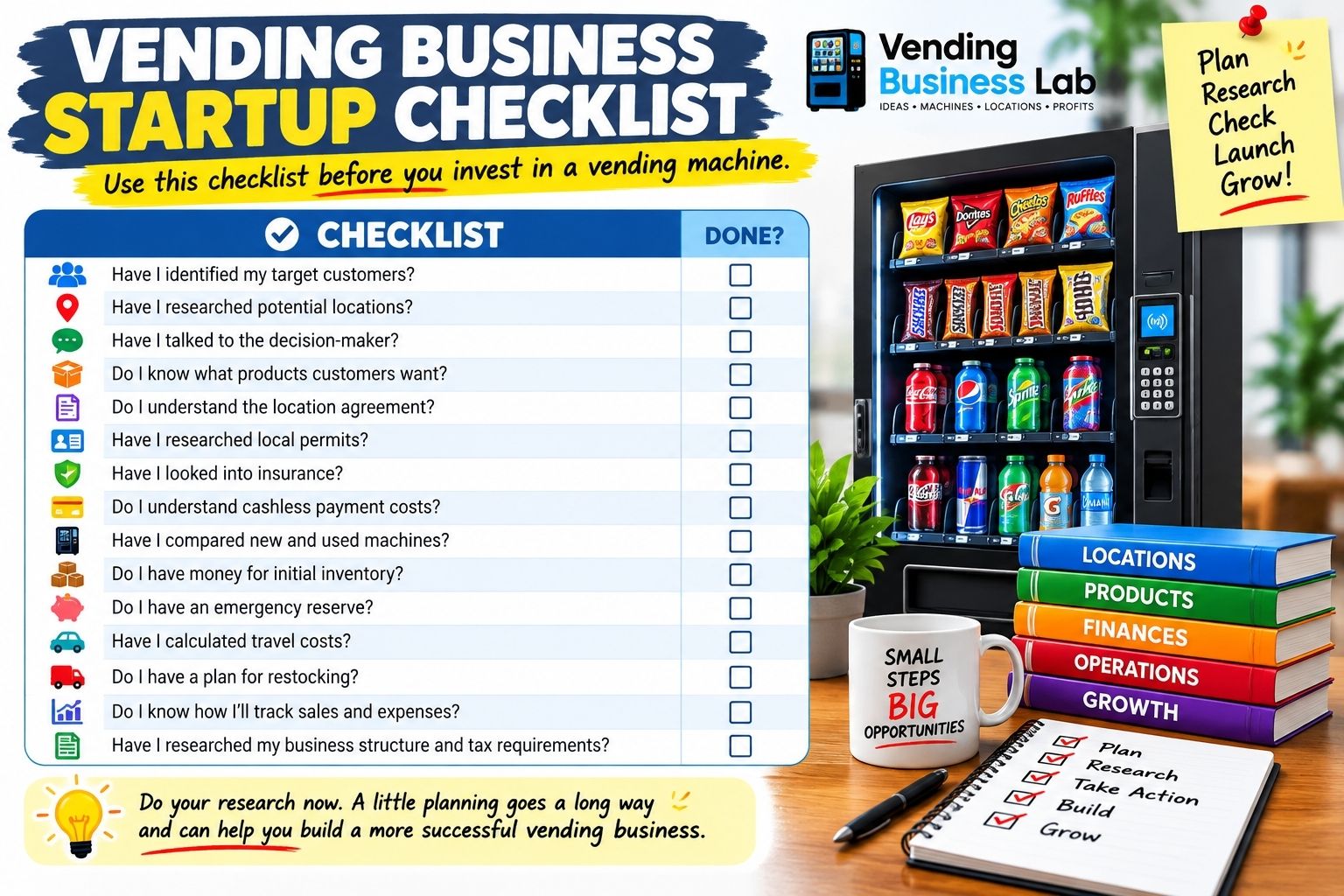
My Vending Business Starter Checklist
Before I spent money, I’d want to answer every question below.

The Biggest Lesson I’m Taking Away From All of This
When I first started looking into vending, I thought the machine was the business.
Now I don’t see it that way.
The machine is the tool.
The business is:
Location + Customers + Products + Operations + Numbers.
If one of those pieces is badly managed, the machine can’t magically fix it.
A $5,000 machine won’t create customers.
A cheap machine won’t make a bad location good.
A great location won’t save you if you can’t keep the machine stocked.
And high sales don’t automatically mean high profit.
That’s why I think beginners should slow down.
You don’t need to become a vending expert overnight.
You don’t need ten machines immediately.
You don’t need a warehouse.
You don’t need a giant website.
You don’t even necessarily need a huge amount of money.
What you need first is a plan.
Final Thoughts: Could Vending Machines Become a Business for You?
I think vending is interesting because the basic idea is incredibly easy to understand.
People want something.
The machine is nearby.
They pay.
They get it.
But building a real business around that simple transaction requires much more thought.
If I were starting today, I’d focus on one thing above everything else:
Find a good opportunity before buying expensive equipment.
I’d research locations.
I’d talk to business owners.
I’d learn what customers want.
I’d calculate the expenses.
I’d compare equipment.
I’d start as lean as possible.
Then I’d let the business teach me what to do next.
And if you’re starting with very little money, don’t let the price of a brand-new vending machine convince you that the entire opportunity is out of reach.
There are used machines.
There are financing options.
There are partnerships.
There are creative equipment deals.
And most importantly, there are ways to start researching and building relationships before spending thousands of dollars.
That’s where I would start.
Not with the machine.
With the opportunity.
Frequently Asked Questions About Vending Machines as a Business
Is a vending machine business profitable?
It can be, but profitability varies greatly by location, products, pricing, machine type, operating costs and other factors. I wouldn’t use somebody else’s revenue as a guarantee for your own business.
How much money do I need to start a vending machine business?
There is no single number. Current estimates range from a few thousand dollars for a very small operation using lower-cost equipment to much higher amounts for multiple new machines. Your location and equipment choices make a major difference.
Can I start a vending machine business with no money?
Starting with literally $0 is difficult because equipment, inventory and operating requirements cost money. However, someone with limited capital can investigate used equipment, financing, partnerships, seller financing and—most importantly—finding a location opportunity before purchasing a machine.
Should I buy a vending machine before finding a location?
I generally wouldn’t recommend rushing into the machine purchase. Understanding the location first can help you choose the appropriate machine and avoid being stuck with equipment you don’t have a place for.
Are vending machines passive income?
I wouldn’t call them completely passive. Someone still needs to restock, maintain, monitor and manage the machines. The amount of work can change considerably as a route grows.
Do vending machines need card readers?
Not necessarily, but cashless payment options are increasingly common and can be important depending on your customers and location. The exact costs and capabilities depend on the payment system.
Do I need an LLC to start a vending business?
Not automatically. Business structure requirements depend on your circumstances and location. Research your state and local requirements before starting, and consider professional advice for your situation.
Where can I find vending machine locations?
You can research businesses through Google Maps, local directories, personal contacts, networking, driving around your area and direct outreach. Potential locations include offices, warehouses, manufacturing facilities, apartment communities, gyms, laundromats, hotels and other places where people spend time.
Should I buy a new or used vending machine?
Either can make sense. Used equipment can reduce the upfront cost, while new equipment may offer newer technology and warranty coverage. I would judge the individual machine, its condition, compatibility and the location rather than automatically choosing one category.
Start With One Step
If you’re seriously considering vending machines as a business, here’s what I’d do today.
Don’t buy a machine yet.
Open Google Maps.
Pick your local area.
Find 25 businesses that might have vending potential.
Put them into a spreadsheet.
Write down:
- Business name
- Location
- Business type
- Estimated customer/employee base
- Existing vending
- Nearby food options
- Contact information
- Distance from you
- Potential decision-maker
Then start making calls.
Because you might discover something much more valuable than a vending machine.
You might discover your first location.
And once you have that, the rest of the business starts becoming much easier to understand.
